
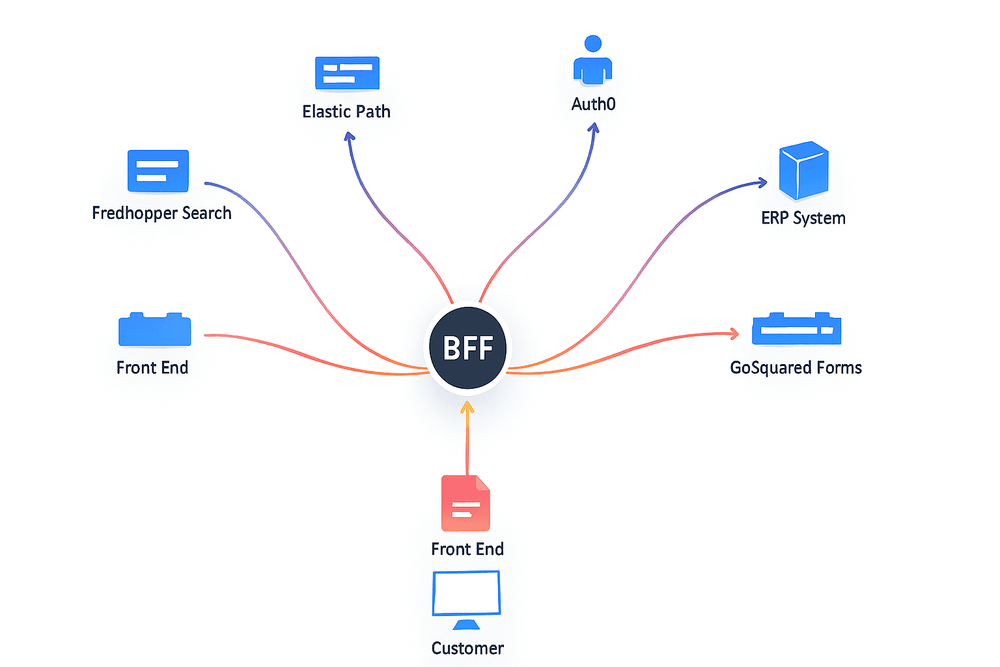
What Is Composable Architecture?
Composable architecture is a modern approach to software architecture that works on the principle of selecting the finest eCommerce components and combining them through a tailored, customised application. This application is constructed with the specific purpose of satisfying unique business needs.
It extends the concept of microservice-based technology, where loosely-coupled services from different vendors can be combined to create cohesive eCommerce solutions.
For example, we could take cloud-based systems and combine them into a single eCommerce web store. These systems might include:
- Elastic Path eCommerce
- Fredhopper Search
- Auth0 for identity management
- Tacton CPQ
- An ERP system for pricing and order placement
- GoSquared Forms
- Google Analytics
- InRiver PIM
By adopting this architecture, businesses are no longer constrained to monolithic application suites tied to licensing restrictions. Instead, they can utilise modular technology from multiple providers. This approach, also called “Packaged Business Capability” (PBC), is flexible, adaptable, and enables improved customer experiences.
For more detail, visit our blog.
Microservices and PBCs
Microservices and PBCs both emphasise modularity and flexibility.
Microservices
Microservices break down applications into independent smaller services that communicate via APIs. Each service performs a specific function, can be developed, deployed, and scaled independently, allowing for flexibility, agility, easier maintenance, and scaling.
Packaged Business Capabilities (PBCs)
PBCs are pre-built, reusable software components representing specific business functions (e.g., inventory or CRM). They are designed for easy integration and can be customised to suit bespoke needs. PBCs allow businesses to select the best technology from multiple vendors rather than being tied to a single suite.
Microservices offer independence through a technical approach; PBCs focus on reusability from a business perspective. Combined, they create efficient composable eCommerce solutions.
Why Use Composable eCommerce?
Benefits
- Flexibility – Choose only the components your business needs to create a tailored solution.
- Scalability – Easily scale up or down to match demand without paying for unused resources.
- Speed – Use pre-built components to innovate faster and reduce development costs.
- Cost-effectiveness – Pay only for required components, optimising resource allocation.
- Integration – Integrate with existing and future systems without large-scale changes.
- Personalisation – Gather and use customer data to create tailored experiences.
- Efficiency – Avoid system-wide risk from upgrades, improving resilience and stability.
Modern businesses face diverse, rapidly changing customer demands and fierce global competition. Composable eCommerce provides the agility needed to stay competitive.
Composable Architecture vs Monolithic Architecture
Monolithic systems bundle all functionality into a single application, making change slow, costly, and risky. Composable eCommerce breaks solutions into independent components that can be modified or replaced without affecting the whole.
This is especially valuable in B2B eCommerce, reducing development costs via pre-built components while offering customisation. Composable solutions balance complexity and agility, keeping businesses in the “Goldilocks Zone” of software design.
Using Elastic Path
We use Elastic Path Commerce Cloud to provide a cloud-based API and state management for core eCommerce functions (baskets, checkout, payments). It integrates with existing systems while allowing eCommerce strategy to evolve. Elastic Path supplies the microservices but not the front-end UI.
The Front End
We build the front end in React using Gatsby, which generates pages at build time for high speed, security, and SEO performance. This avoids slow runtime API calls and supports integration with platforms like Shopify and Magento.
Back End For The Front End (BFF)
Some data (search, pricing, availability) is retrieved at runtime via secure APIs. To protect credentials, we use a server-side BFF that the front end calls. The BFF communicates with microservices securely, adding minimal latency and ensuring cookie/domain compatibility.
Graceful Fallback During Downtime
If a microservice (e.g., ERP) is slow or offline, the BFF times out quickly and returns an “unknown” status with a friendly message. This keeps the site fast and responsive even when some services degrade.
No Database
Our solution operates without a customer database, reducing support needs:
- Elastic Path handles baskets/accounts
- ERP stores orders
- Users managed via Auth0
Conclusion
This has been a quick overview of composable eCommerce benefits and structure. At McKenna Consultants, we’ve delivered bespoke B2B composable architecture solutions tailored to client needs. Learn more about software integration or digital development, or contact us to discuss your project.